
6 min read
NetSuite Project Recovery: How to Rescue a Failing NetSuite Implementation
Is your NetSuite implementation jeopardizing your quarter‑end close, audit readiness, or executive credibility? That’s not paranoia,...
13 min read

The future of ERP will be defined by cloud-based ERP platforms with embedded AI capabilities, intelligent automation, and composable architectures that allow organizations to assemble functionality from modular product lines and APIs.
Gartner forecasts that by 2027, 62% of ERP application spending will be on solutions with embedded AI capabilities, up from 14% in 2024, signaling a structural shift in how modern business systems operate and what C-suite leaders should expect from their system of record. Oracle NetSuite and other modern ERP platforms are already moving in this direction through investments in AI tools, real-time insights, and ecosystem integration.
Enterprise resource planning in 2026 looks fundamentally different from what it did five years ago. Cloud ERP platforms have moved from optional to essential, artificial intelligence has shifted from experimental to embedded, and the ERP market itself is consolidating around ERP providers who can deliver real-time data, intelligent automation, and composable architectures.
Today, NetSuite ERP's roadmap reflects the same forces reshaping the broader future of cloud ERP: AI-powered workflows, agentic automation, API-driven extensibility, and real-time analytics that turn business data into actionable insights. Understanding how NetSuite is evolving offers a practical lens for evaluating where the entire ERP technology category is headed and what decisions C-suite leaders should prioritize in the near term.
Cloud-based ERP platforms with embedded AI capabilities will become the standard system of record for large enterprises and mid-market firms by 2027.
Generative AI and AI-powered intelligent automation will move ERPs from reporting tools to proactive workflow engines that automate approval, order fulfillment, and anomaly detection.
NetSuite is positioned as a modern ERP leader with continuous process updates, built-in AI tools, and API-driven extensibility through SuiteCloud and SuiteTalk.
C-suites must prioritize clean business data, real-time dashboards, and pilot projects with AI capabilities to stay competitive and prepare for agentic workflows.
Ensuring their ERP can evolve with new features, APIs, and enterprise-grade automation is now a strategic decision, not a technical one.
Evaluate your current ERP system against technology readiness, data maturity, workflow automation, and vendor roadmap clarity to identify gaps before they become constraints.
The ERP solution you choose, the architecture you build, and the automation you enable today will either support or limit your ability to adopt AI tools, streamline business processes, and respond to constantly evolving market conditions. This section explains why the future of ERP is not just about software upgrades, but about positioning your core business systems to handle digital transformation pressures that will only intensify.
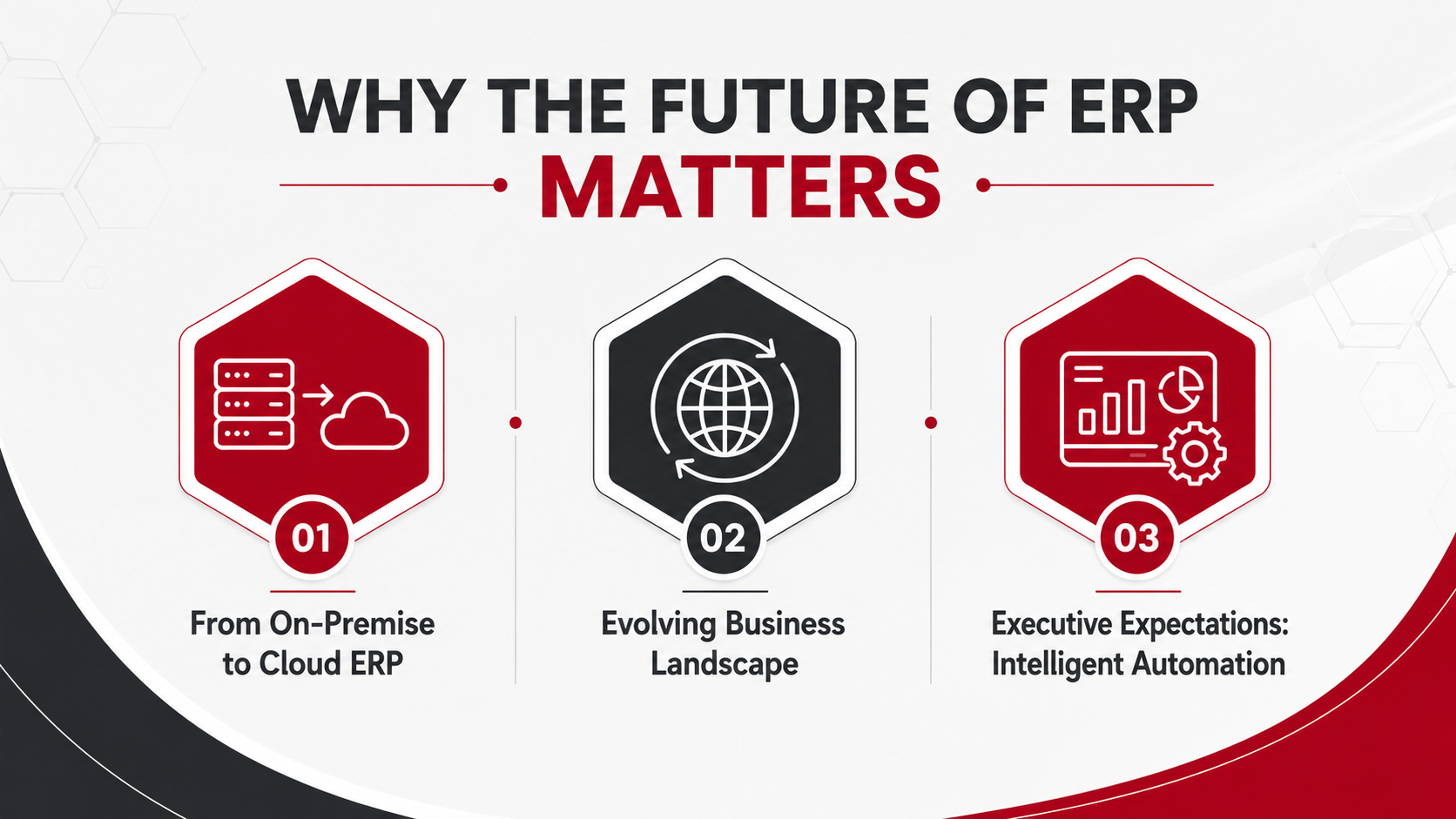
The shift from on-premise ERP systems to cloud-based ERP is a foundational change in how enterprise resource planning works. On-premises ERP deployments required manual data entry, siloed databases, and IT teams to manage infrastructure. Cloud ERP platforms like NetSuite eliminate those constraints by centralizing business data in a single system of record, automating updates, and enabling real-time access from anywhere through mobile ERP capabilities and modern user interface design.
This matters because modern business operations depend on speed. Sales order processing, order fulfillment, inventory management, and financial close cycles all move faster when the ERP technology itself is designed for real-time data flow. Cloud-based ERP also makes it easier to integrate with other digital technology, from marketing automation platforms to customer experience tools, because APIs and built-in connectors replace custom code. The result is an ERP system that evolves with your business instead of requiring expensive reimplementation every few years.
Digital transformation is not a one-time initiative. It is a continuous process of adapting core business processes to new customer expectations, competitive threats, and operational efficiency demands. Growing businesses in 2026 require ERPs that can support rapid change without breaking existing workflows.
Digital Transformation Demands: C-suite leaders expect their ERP solution to support new business models, automate approval workflows, and provide role-based dashboards that surface KPIs and actionable insights in real time.
Workflow Flexibility: The ability to streamline and automate workflows later depends on decisions made now about data structure, integration architecture, and whether the ERP vendor invests in new features and AI capabilities.
Competitive Pressure: Large enterprises and mid-market firms that rely on manual data entry, static reports, and disconnected systems will lose ground to competitors using cloud-based ERP platforms with intelligent automation and real-time visibility.
The shift in executive expectations is one of the clearest signals that the future of ERP has already arrived. Five years ago, a dashboard with basic KPIs was considered advanced. Today, C-suite and analyst teams expect role-based dashboards that update in real time, natural language queries that return actionable insights without SQL, and AI-powered anomaly detection that flags issues before they become problems.
This change reflects a broader move from reactive reporting to proactive automation. Enterprise-grade intelligent automation means the ERP system itself can identify bottleneck activities, suggest optimization opportunities, and route approvals or exceptions without human intervention. Oracle NetSuite's investments in SuiteAnalytics, NSAW (NetSuite Analytics Warehouse), and built-in AI tools show how modern ERP platforms are responding to these expectations. The question for C-suite leaders is whether their current ERP system can deliver this level of functionality, or whether it will require a platform change to stay competitive.
Here is a 5–10 year forecast of the core trends that will define the future of ERP and the future of NetSuite. Each trend explains how ERP technology is changing functionally, why it matters for core business systems and business data, and how Oracle NetSuite is already moving in that direction.
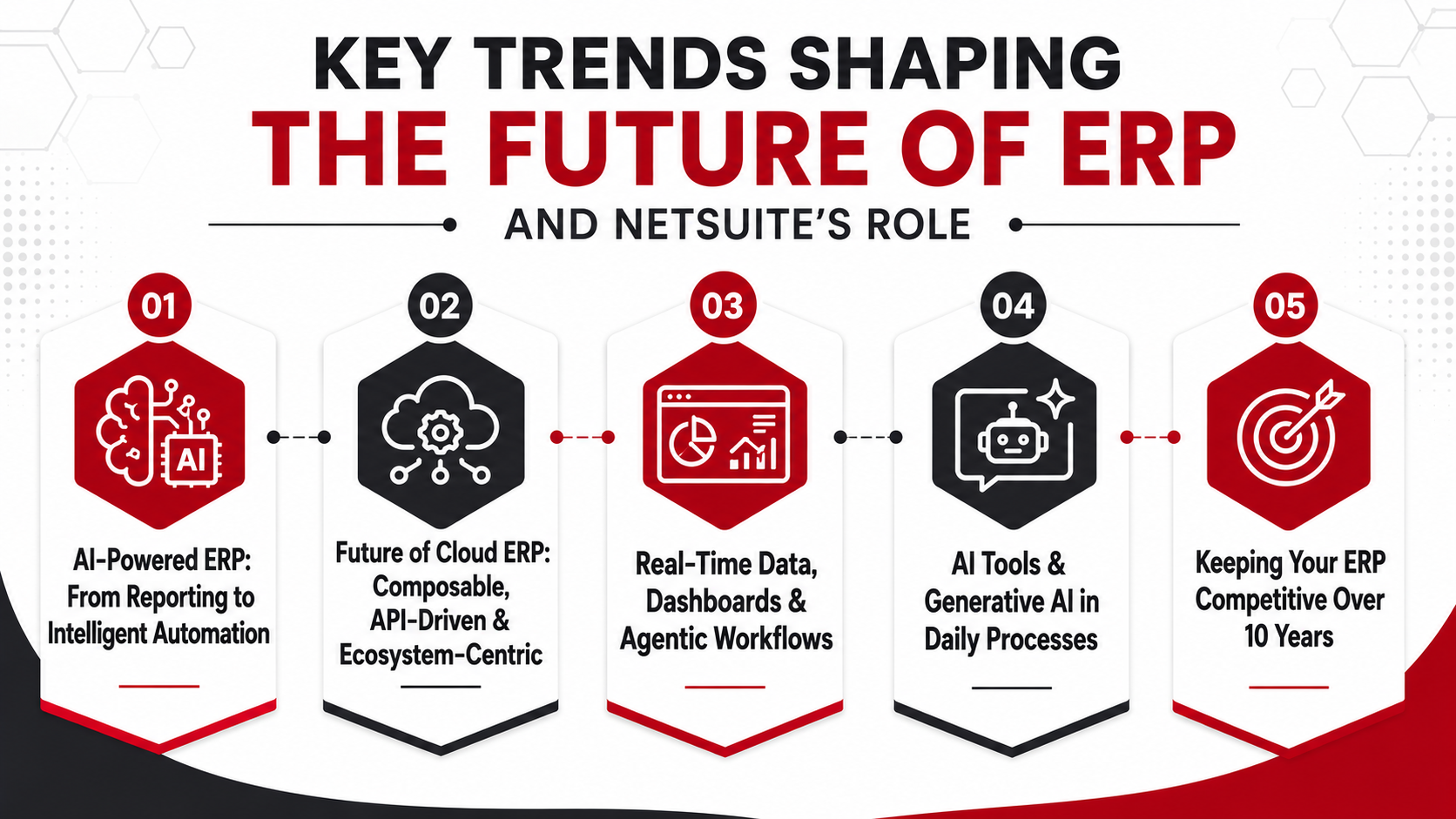
Artificial intelligence is moving ERPs from tools that report what happened to systems that predict what will happen and automate responses. The future of ERP involves embedding AI-powered logic into every workflow, from forecasting and demand planning to anomaly detection and approval routing.
NetSuite's AI tools analyze business data, surface metric trends, and suggest optimization actions. These tools use generative AI to interpret natural language queries, allowing analysts to ask questions like "which sales orders are at risk of delay" and receive answers without building custom reports. Agentic patterns take this further by allowing the ERP system to act on insights autonomously, such as rerouting order fulfillment when inventory levels drop or flagging approval workflows that exceed normal cycle times.
The practical impact is that intelligent automation reduces manual data entry, eliminates bottleneck activities, and frees teams to focus on strategic work instead of data reconciliation. This means the ERP solution becomes a source of competitive advantage rather than just a system of record. The key is ensuring that the software vendor invests in AI capabilities that are built-in, not bolted on, and that the underlying business data is clean enough to support AI-powered models.
AI and ML technology integrated into ERP systems now enable organizations to analyze data faster and generate deeper insights from ERP data across business units. These advanced analytics capabilities help companies identify patterns in inventory management, human resources, and financial performance that would be impossible to detect through manual analysis.
Read Next: NetSuite Reporting & Business Intelligence: How Smart Teams Drive Decisions
The next generation of cloud-based ERP platforms will be composable, meaning organizations can assemble the exact functionality they need from modular product lines, APIs, and third-party integrations. This shift reflects a broader move away from monolithic ERP systems that try to do everything and toward ecosystem-centric architectures that connect best-of-breed tools through APIs.
Composable Architecture: Cloud ERP platforms like Oracle NetSuite use APIs and microservices to allow organizations to add or remove functionality without reimplementing the entire system, making it easier to adopt new features as business models evolve.
Integration Priorities: NetSuite's SuiteCloud platform, SuiteTalk APIs, and SuiteAnalytics enable integration with CRM, marketing automation, e-commerce, and other digital technologies, turning the ERP into a central hub rather than a standalone system.
Procurement and Continuous Evolution: This changes how organizations think about ERP technology procurement, shifting from multi-year implementation cycles to continuous process improvement where new capabilities are added incrementally as business needs change.
Kimberlite Partners delivers NetSuite integration services that connect Oracle NetSuite with CRM, e-commerce, and marketing automation through custom integration solutions. Integration expertise helps organizations create unified system ecosystems where real-time data flows across platforms, eliminating manual data entry and enabling the composable, API-driven architectures that define the future of cloud ERP.
The experience of using an ERP system is changing. Static reports and batch processing are being replaced by real-time dashboard views, role-based KPIs, and natural language interfaces that allow users to interact with business data conversationally. This shift reflects the broader expectation that enterprise resource planning should feel as responsive as consumer applications.
Oracle NetSuite's dashboards and SuiteAnalytics provide real-time visibility into financial performance, operational efficiency, and customer experience metrics. NSAW extends this by allowing analysts to run complex queries across large datasets without impacting system performance. This enables you to get actionable insights faster, identify optimization opportunities earlier, and make decisions based on current data instead of last week's reports.
Agentic workflows take this further by allowing the ERP system to act on real-time data autonomously. For example, an agentic workflow might automatically escalate a sales order that exceeds a certain threshold, reroute order fulfillment to a different warehouse based on inventory levels, or flag approval workflows that are taking longer than expected. This level of automation requires an ERP solution that is designed for real-time data flow and has the AI capabilities to interpret context and take appropriate action.
The most immediate impact of generative AI on the future of ERP will be felt in daily business processes. AI tools are being embedded directly into workflows like marketing automation, sales order optimization, approval routing, and anomaly detection, reducing the need for manual intervention and improving operational efficiency.
Marketing Automation: AI-powered tools inside Oracle NetSuite can analyze customer data, segment audiences, and recommend next-best actions for campaigns, turning the ERP into a source of customer experience insights.
Sales Order Optimization: Generative AI can predict which sales orders are at risk of delay, suggest alternative fulfillment options, and automate approval workflows based on historical patterns and real-time data.
Approval Workflows: Built-in AI tools can route approvals to the right person based on context, flag exceptions that require human review, and learn from past decisions to improve accuracy over time.
Anomaly Detection: AI-powered anomaly detection can identify unusual patterns in business data, such as unexpected spikes in order fulfillment costs or deviations from forecast, and alert teams before issues escalate.
The key advantage of built-in AI tools is that they work with the business data already in the ERP system, eliminating the need to export data to external analytics platforms or build custom integrations. For NetSuite users, this means AI capabilities are available out of the box, reducing the time and cost required to adopt intelligent automation.
IoT and advanced analytics are increasingly integrated into ERP systems, enabling real-time monitoring of equipment, inventory, and supply chain operations. These additional capabilities help organizations streamline processes across business functions, from inventory management to human resources, by connecting physical assets and operational data directly within the ERP.
The final trend shaping the future of ERP is long-term competitiveness. The ERP solution you choose today should be able to support business growth, adopt new features, and integrate with emerging digital technology for at least the next decade. This requires a shift in how organizations evaluate ERP vendors and make investment decisions.
NetSuite's continuous process of updates, demonstrated through SuiteWorld announcements and regular product releases, shows a commitment to keeping the platform current. New features like enhanced AI tools, expanded APIs, and improved analytics capabilities are delivered automatically to all customers, ensuring that the ERP system evolves without requiring manual upgrades or reimplementation. This model contrasts with on-premise ERP systems that require expensive upgrade projects every few years and often lag behind cloud-based ERP platforms in functionality.
Future-proofing your business means selecting ERP providers and software vendors who invest in continuous innovation rather than treating the ERP as a static product. Cloud-based ERP solutions deliver new features and additional capabilities automatically, ensuring that companies of all sizes can stay competitive without the cost and disruption of traditional upgrade cycles.
This approach to ERP software evolution represents a fundamental shift in how organizations should think about their core ERP system as a platform for continuous improvement rather than a fixed implementation.
Read Next: The Future of ERP: How AI & Automation Are Changing NetSuite
Use these checklists to identify gaps in technology readiness, data maturity, workflow automation, and vendor alignment before they become constraints on business growth.
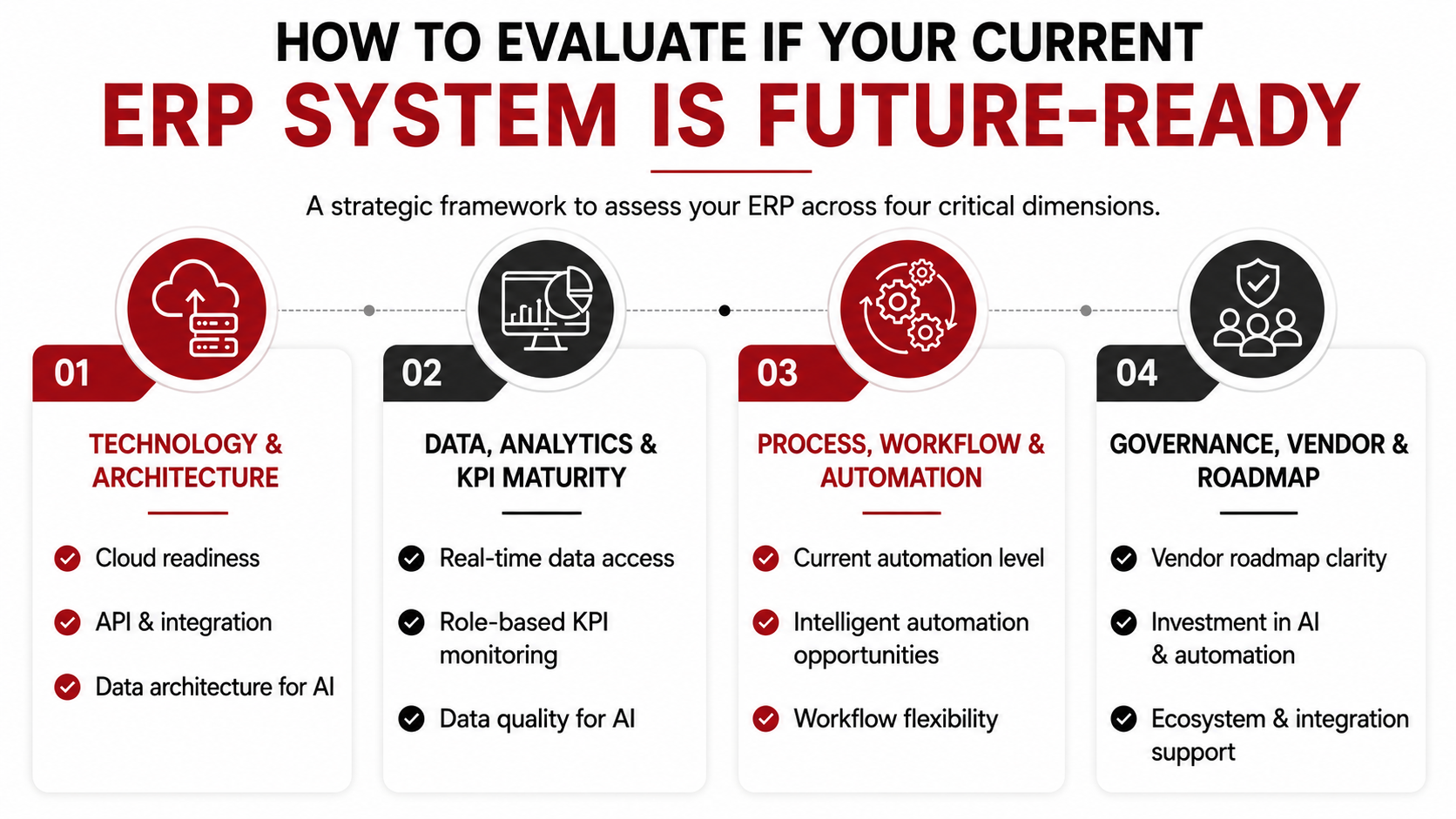
Your ERP technology foundation determines what is possible. If the architecture is not designed for cloud-based ERP, APIs, and AI capabilities, adding those features later will be expensive and disruptive.
Cloud-Based ERP Verification: Confirm whether your ERP system is truly cloud-based ERP or just hosted on-premise infrastructure, as the distinction affects scalability, update frequency, and integration flexibility.
API and Integration Readiness: Evaluate whether your ERP solution exposes APIs for integration with CRM, marketing automation, e-commerce, and other digital technologies, and whether those APIs are well-documented and actively maintained.
Data Architecture for AI: Assess whether your business data is structured in a way that supports AI-powered models, including clean data entry, consistent naming conventions, and real-time data flow across modules.
The quality of your business data determines the value you can extract from analytics, dashboards, and AI tools. If data is siloed, inconsistent, or delayed, even the best ERP solution will struggle to deliver actionable insights.
Real-Time Data Access: Verify whether your ERP system provides real-time data access for dashboards, KPIs, and reporting, or whether reports are generated in batch mode with delays.
Role-Based KPI Monitoring: Evaluate whether your ERP solution supports role-based dashboards that surface relevant KPIs for different teams, such as financial close metrics for finance, order fulfillment metrics for operations, and customer experience metrics for sales.
Data Quality for AI: Assess whether your business data is clean, complete, and consistent enough to support AI-powered models and generative AI tools, as poor data quality will limit the effectiveness of intelligent automation.
The level of automation in your core business processes determines how much manual effort is required to run the business. If workflows still depend on manual data entry, email approvals, and spreadsheet reconciliation, the ERP system is not delivering its full value.
Current Automation Level: Evaluate the current level of automation for core business workflows like order fulfillment, sales order processing, approval routing, and financial close, and identify where manual data entry and bottleneck activities still exist.
Intelligent Automation Opportunities: Identify where intelligent automation could replace manual processes, such as using AI-powered anomaly detection to flag exceptions, automating approval workflows based on business rules, or using generative AI to optimize order fulfillment routing.
Workflow Flexibility: Assess whether your ERP solution allows you to modify workflows, add new automation, and integrate with other systems without requiring custom code or expensive consulting engagements.
The ERP vendor's roadmap and investment priorities determine whether the platform will stay competitive over the next 5–10 years. If the vendor is not investing in AI capabilities, cloud-based ERP, and new features, the system will become a constraint on business growth.
Vendor Roadmap Clarity: Evaluate whether your ERP vendor shares a clear future of ERP roadmap, such as through Gartner recognition, SuiteWorld announcements, or public product updates, and whether that roadmap aligns with the key trends shaping the ERP market.
Investment in AI and Automation: Assess whether Oracle NetSuite or other ERPs you use are actively investing in AI tools, generative AI, intelligent automation, and agentic workflows, as these capabilities will become table stakes for modern ERP platforms.
Ecosystem and Integration Support: Verify whether the ERP vendor supports a strong ecosystem of third-party integrations, APIs, and partner solutions, as this determines how easily you can extend the platform to support new business models and digital technology.
It's crucial to start aligning near-term actions (2026–2027) with longer-horizon decisions to balance immediate operational needs with strategic positioning for the future of ERP. The goal is to make progress without committing to a path that limits flexibility or locks in the wrong architecture.
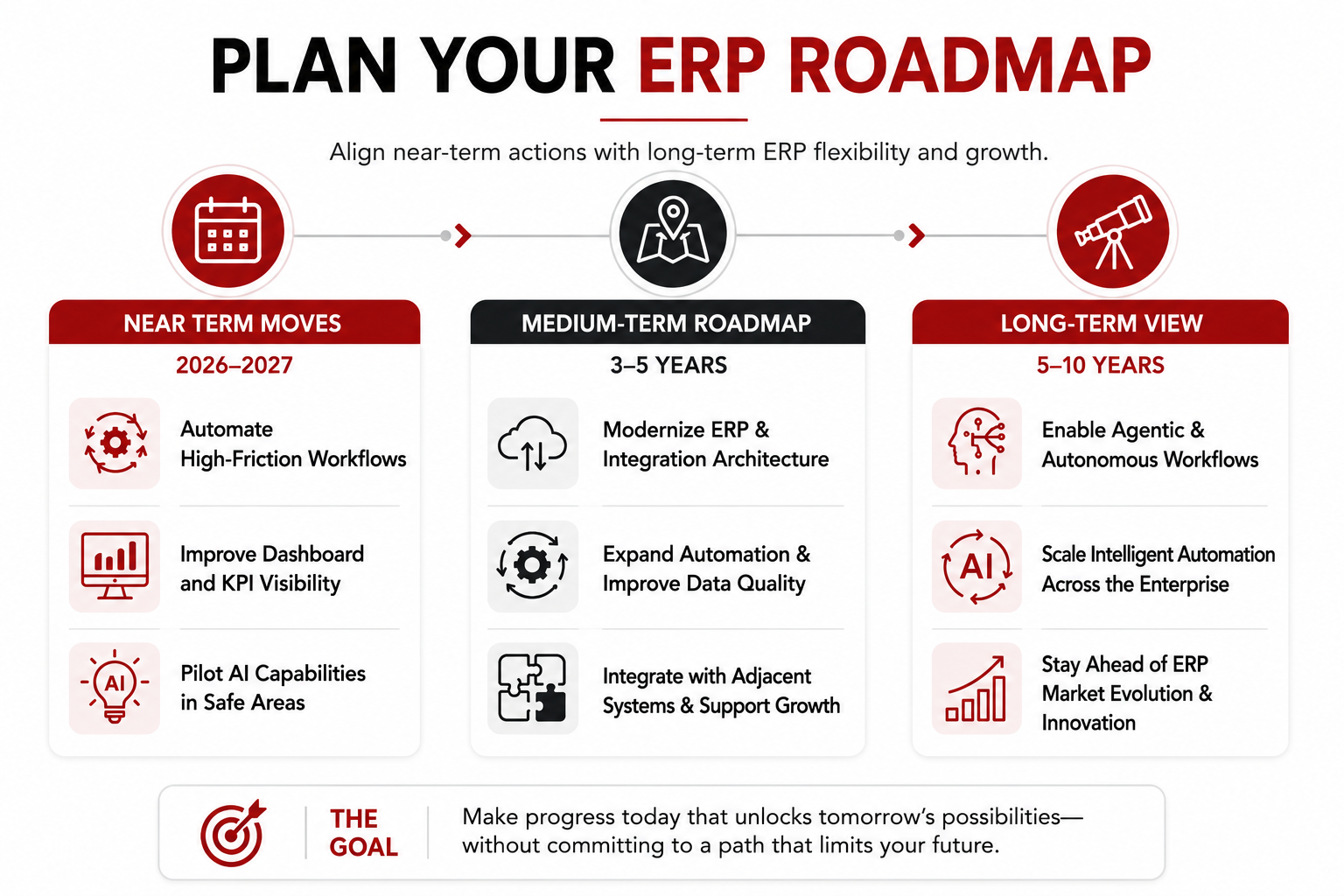
The next 12–24 months should focus on quick wins that improve operational efficiency, build data foundations, and create space for experimentation with AI capabilities and intelligent automation.
Automate High-Friction Workflows: Identify the workflows that create the most manual effort, such as approval routing, order fulfillment exceptions, or financial close reconciliation, and automate them using Oracle NetSuite's built-in workflow tools or SuiteFlow.
Improve Dashboard and KPI Visibility: Deploy role-based dashboards that surface real-time data and actionable insights for key teams, ensuring that leaders can monitor business performance without waiting for monthly reports.
Pilot AI Capabilities in Safe Areas: Launch pilot projects with AI tools and generative AI in well-governed areas, such as anomaly detection for expense reports or AI-powered forecasting for demand planning, to build confidence and learn how to scale intelligent automation.
The 3–5 year horizon should focus on modernizing enterprise resource planning architecture, expanding automation, and ensuring that the ERP solution can support new business models and digital transformation initiatives.
The modernization phase of enterprise resource planning, cloud ERP, and integration architecture depends on the current state and business priorities. Organizations still running on-premise ERP systems should prioritize migration to cloud-based ERP platforms to unlock real-time data, API-driven integration, and continuous process updates. Those already on cloud ERP should focus on expanding automation, improving data quality, and integrating with adjacent systems like CRM, marketing automation, and e-commerce.
Organizations experiencing rapid business growth, entering new markets, or launching new business models should review their ERP system annually to ensure it still aligns with operational needs. Those in more stable environments can extend the review cycle to 18–24 months, but should still monitor advancements and updates to stay informed about new features and key trends in the ERP market.
Working with a NetSuite partner during this phase helps organizations evaluate customization needs, assess additional capabilities, and plan for seamless integration across business units. A qualified NetSuite partner can help identify where customization adds value versus where standard functionality should be preserved, ensuring that the ERP remains maintainable and upgradeable as NetSuite launches new features and management capabilities.
The 5–10 year view requires thinking about agentic, autonomous workflows, intelligent automation across departments, and evolving ERP market dynamics. The future of ERP will be defined by systems that can learn, adapt, and act with minimal human intervention, turning enterprise resource planning from a system of record into a system of action.
Thinking about agentic, autonomous workflows, intelligent automation across departments, and evolving ERP market dynamics starts with recognizing that the ERP solution you choose today will either enable or constrain your ability to adopt these capabilities later. NetSuite's advancements in AI-powered automation, API-driven extensibility, and continuous process updates position it as a platform that can evolve with these trends, but organizations must also invest in clean business data, strong governance, and skilled teams to realize the full value.
The future of ERP is unfolding now through cloud-based ERP platforms, AI-powered automation, and composable architectures that turn enterprise resource planning into a source of competitive advantage. The decisions business owners make today about their ERP solution, data architecture, and automation strategy will determine whether their organization can stay competitive, support business growth, and adopt new features as the business landscape continues to evolve.
Prioritize Cloud ERP: Cloud-based ERP platforms with strong AI capabilities are now table stakes to stay competitive and support digital transformation initiatives over the next 5–10 years.
Build Data Foundations: Clean, connected business data and real-time dashboards unlock actionable insights and optimization opportunities that manual data entry and static reports cannot deliver.
Think Beyond Features: Ensuring their ERP can evolve with new features, APIs, and agentic automation is strategic, not just technical, and requires selecting vendors and partners who invest in the future of ERP.
Kimberlite Partners provides NetSuite managed services that deliver proactive monitoring, continuous optimization, and ongoing support that help organizations maintain system performance and alignment with evolving business needs. Our approach ensures that NetSuite continues to support business growth as the business landscape evolves, with predictable support costs and reduced downtime that protects long-term value.
Schedule a free consultation to discuss your NetSuite implementation goals and identify gaps in system readiness, data migration planning, process alignment, and automation opportunities.
The future of ERP will be defined by cloud-based ERP platforms with embedded AI capabilities, intelligent automation, and composable architectures that allow organizations to assemble functionality from modular product lines and APIs. Oracle NetSuite and other modern ERP platforms are already moving in this direction through investments in AI tools, real-time insights, and ecosystem integration.
Artificial intelligence will move ERPs from reactive reporting tools to proactive automation engines that predict issues, optimize workflows, and act autonomously. AI-powered capabilities like anomaly detection, generative AI for natural language queries, and agentic workflows will reduce manual data entry, eliminate bottleneck activities, and improve operational efficiency.
Oracle NetSuite is positioned as a leader in the future of cloud ERP based on its continuous process of updates, investments in AI tools and intelligent automation, and API-driven extensibility through SuiteCloud and SuiteTalk. Gartner recognition and SuiteWorld announcements demonstrate NetSuite's commitment to staying current with key trends shaping the ERP market.
C-suite leaders should prioritize clean business data, real-time dashboards, and pilot projects with AI capabilities to build foundations for intelligent automation. Near-term moves should focus on automating high-friction workflows, improving KPI visibility, and experimenting with AI tools in well-governed areas to prepare for agentic workflows.
Evaluate your current ERP system against technology readiness (cloud-based ERP, APIs, data architecture), data maturity (real-time data, role-based KPIs, data quality), workflow automation (current automation level, intelligent automation opportunities), and vendor roadmap clarity (investment in AI capabilities, ecosystem support). Gaps in any of these areas indicate constraints on business growth.
Agentic workflows will allow ERP systems to act autonomously based on real-time data and AI-powered logic, such as rerouting order fulfillment, escalating approvals, or flagging anomalies without human intervention. This level of intelligent automation requires cloud-based ERP platforms with strong AI capabilities, clean business data, and API-driven integration.

6 min read
Is your NetSuite implementation jeopardizing your quarter‑end close, audit readiness, or executive credibility? That’s not paranoia,...

Organizations that rely on service-oriented workflows need robust project management software to keep tasks, budgets, and timelines in sync....

Operations and finance leaders at professional services firms face a unique balancing act: keeping projects staffed, clients happy, and revenue...