6 min read

Why NetSuite Implementations Fail to Deliver Long-Term Value

Why NetSuite Implementations Fail to Deliver Long-Term Value

NetSuite is often positioned as a long-term cost saver—and in many cases, it is. By eliminating on-premise infrastructure, consolidating systems, and providing real-time operational visibility, NetSuite gives growing companies a platform designed to scale. But that value is not automatic, and it is rarely realized simply by turning the system on.

One of the most common mistakes organizations make is assuming that because NetSuite reduces costs over time, the implementation itself should be treated as an area to minimize investment. In practice, the opposite is true. The decisions made during implementation establish the structural foundation of the system—how data flows, how processes are enforced, how reporting is consumed, and how easily the platform can adapt as the business changes.

Industry research consistently shows that ERP programs that underinvest in implementation planning and design are far more likely to underperform over their lifetime, often requiring expensive rework within the first 18 to 36 months. What initially appears as savings at go-live often reemerges later as manual work, poor adoption, and missed insight.

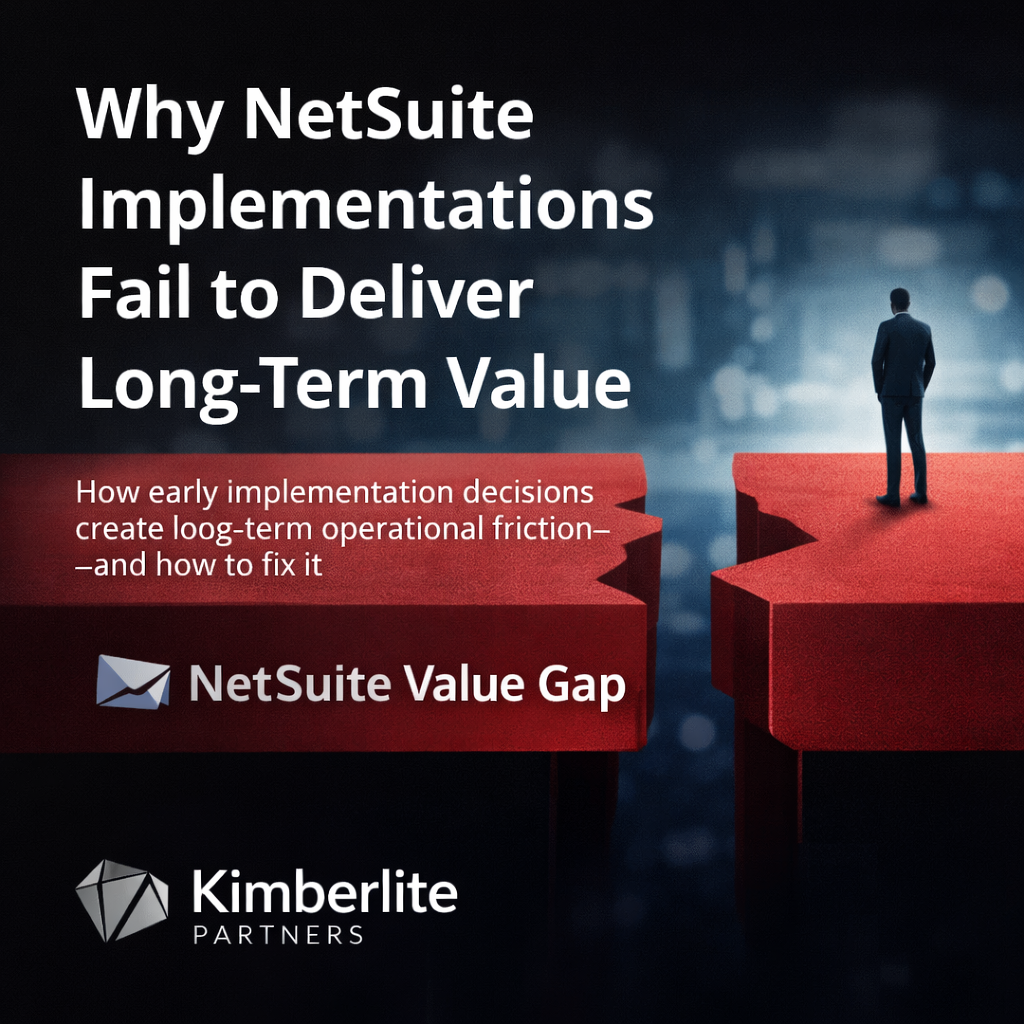
At Kimberlite Partners, we see this pattern repeatedly. Organizations don’t struggle with NetSuite because the platform lacks capability. They struggle because early implementation decisions—often driven by cost, speed, or limited guidance—create misalignment that compounds over time. That misalignment is what we refer to as the NetSuite Value Gap: the growing distance between what NetSuite is capable of delivering and the value a business is actually realizing.

Understanding how that gap forms starts with understanding the risks embedded in a tactical implementation approach.

What’s at Risk in a Tactical NetSuite Implementation

A tactical NetSuite implementation focuses on getting the system live as quickly and inexpensively as possible. While this approach may satisfy short-term budget or timeline pressures, it often introduces structural weaknesses that surface long after go-live.

Low-cost implementation models frequently rely on shared or lightly guided delivery. Consultants provide generalized advice, but responsibility for defining processes, making configuration decisions, and validating outcomes falls largely on internal teams. Without deep NetSuite experience, those teams are forced to make critical choices without fully understanding their long-term impact.

The risk isn’t that NetSuite won’t work. The risk is that it will work in ways that subtly undermine efficiency.

Industry data suggests that ERP environments misaligned with business processes can increase operational overhead by 15–30% over time, driven by manual rework, fragmented reporting, and process workarounds. These costs rarely appear as a single line item. Instead, they accumulate quietly across finance, operations, and leadership teams.

Common symptoms of a tactical implementation include:

  • Processes that don’t reflect how work actually gets done

  • Reporting that requires heavy spreadsheet manipulation outside NetSuite

  • Rigid configurations that are difficult to modify as the business changes

  • Growing dependence on custom scripts to compensate for poor design

Many discount implementation partners rely on checklist-driven methodologies. Tasks are completed, features are enabled, and boxes are checked—without evaluating whether the configuration supports the business model or future growth. The result is a system that meets basic requirements but lacks strategic intent.

Over time, organizations often find themselves locked into a NetSuite configuration that no longer fits. Changing it feels risky, expensive, or disruptive, so teams adapt by creating manual processes around the system. What started as a cost-saving decision during implementation becomes a long-term drag on performance.

This is the point where implementation shortcuts evolve into systemic misalignment—and where the Value Gap begins to widen.

Why a Business-First Approach Prevents the Value Gap

A business-first NetSuite implementation shifts the focus from software setup to operational outcomes. Instead of asking, “How do we configure NetSuite?” the question becomes, “How should NetSuite support the way this business actually runs—today and in the future?”

This distinction is critical. NetSuite’s flexibility means there are multiple ways to configure nearly every process, from order-to-cash and procure-to-pay to revenue recognition and financial reporting. When those decisions are made without a deep understanding of the business, the system may technically function, but it rarely operates efficiently.

Organizations that implement NetSuite using a business-first approach consistently see stronger adoption and faster realization of value. Industry studies show that ERP projects aligned to business processes—not just technical requirements—are significantly more likely to meet ROI expectations, because users are not forced to work around the system to get their jobs done.

Equally important, a business-first approach accounts for change. Most companies will evolve materially within a few years of implementation—through growth, acquisitions, new product lines, or organizational restructuring. When NetSuite is configured solely around a static snapshot of the business, those changes introduce friction almost immediately.

By contrast, implementations designed with future-state flexibility in mind allow NetSuite to scale and adapt alongside the organization. This is often the difference between an ERP that supports growth and one that quietly constrains it.

A business-first foundation doesn’t just improve the initial implementation. It reduces the likelihood that NetSuite will fall out of alignment later—delaying or even preventing the formation of the Value Gap.

Why Experience and Certification Still Matter

NetSuite’s flexibility is one of its greatest strengths—but it is also what makes the platform unforgiving when configuration decisions are made without sufficient experience. Many implementation choices appear reasonable in isolation, yet create downstream limitations that only surface months or years later.

This is where experience and certification matter.

NetSuite certification was designed to distinguish consultants who understand not just how to configure the system, but how those configurations behave at scale. The certification process requires demonstrated knowledge across financials, operations, reporting, and system architecture, and it is intentionally rigorous. Consultants who pursue certification tend to do so because they work with NetSuite deeply and continuously, not occasionally.

However, certification alone is not enough. Real value comes from applying that knowledge across many different business models and operational environments. Consultants who have seen hundreds of NetSuite environments understand common failure patterns, recognize early warning signs of misalignment, and know when a “quick fix” will create long-term technical debt.

At Kimberlite Partners, our teams include former NetSuite ACS architects and senior functional consultants who have spent years designing, implementing, and remediating NetSuite environments. That background allows us to evaluate configuration decisions through a long-term lens—considering scalability, maintainability, and future change, not just immediate requirements.

Organizations that work with experienced, certified NetSuite consultants are far more likely to avoid structural issues that later require costly rework. More importantly, they are better positioned to continue extracting value from NetSuite as the business evolves.

This difference in expertise is often invisible at go-live but it becomes unmistakable over time.

From Implementation Decisions to the NetSuite Value Gap

Even when a NetSuite implementation is executed thoughtfully, the work is not finished at go-live. Implementation establishes the foundation—but what happens next determines whether that foundation continues to support the business or slowly becomes a constraint.

The same forces that undermine poor implementations also affect strong ones over time. Businesses change. Teams grow. New products, entities, and acquisitions introduce complexity. Reporting needs evolve. When NetSuite does not evolve at the same pace, misalignment is inevitable.

This misalignment is what Kimberlite Partners refers to as the NetSuite Value Gap: the widening distance between the value NetSuite is capable of delivering and the value the organization is actually realizing today.

Industry observations consistently show that 30–40% of ERP functionality often goes unused in mature environments. This is rarely because the software lacks capability. More often, it’s because no one is accountable for continuously reassessing how the system supports current operations. Configuration decisions that once made sense remain untouched long after the business has moved on.

As the Value Gap expands, organizations begin to feel the effects:

  • Manual processes creep back into daily workflows

  • Reporting becomes slower and less reliable

  • Close cycles extend instead of compress

  • Users lose confidence in the system

At this stage, NetSuite is usually still “working”—but it is no longer working for the business. And because the system technically functions, the gap often goes unaddressed until inefficiency becomes unavoidable.

Understanding the Value Gap reframes NetSuite success. It’s not defined by a successful implementation alone, but by the system’s ability to remain aligned as the business evolves.

Kimberlite’s Answer: DiamondCare Managed Services

Kimberlite Partners was built around a simple observation: most NetSuite challenges don’t stem from poor software, but from a lack of continuous alignment between the system and the business. Implementations—no matter how strong—address a moment in time. DiamondCare was created to address everything that follows.

DiamondCare is Kimberlite’s managed services model designed to keep NetSuite aligned with how your business actually operates. Rather than reactive support or periodic clean-up projects, DiamondCare provides ongoing, structured optimization that evolves as the organization evolves.

Our work begins by reestablishing system fit. We assess how your business operates today and compare that reality against NetSuite’s current configuration, identifying areas where manual work, reporting gaps, or process friction have emerged. From there, we enhance workflows, automation, permissions, integrations, and analytics to restore efficiency and clarity.

As the business continues to change, DiamondCare ensures NetSuite changes with it. New entities, acquisitions, modules, and operational models are incorporated deliberately, without introducing unnecessary complexity or technical debt. This continual realignment prevents the Value Gap from reopening.

DiamondCare also changes the economics of NetSuite ownership. Instead of unpredictable consulting engagements or deferred enhancement backlogs, organizations receive consistent access to senior-level NetSuite expertise. Value is delivered continuously, not episodically, and the system improves month after month rather than stagnating between projects.

The result is a NetSuite environment that remains relevant, trusted, and fully utilized long after go-live.

The Bottom Line

NetSuite does not deliver value simply by being implemented. It delivers value when it continues to reflect how the business operates, adapts to change, and provides clarity rather than friction. The same decisions that influence implementation success also determine whether NetSuite remains an asset or becomes a constraint over time.

Organizations that cut corners early often pay for it later. Those that treat NetSuite as a living system—one that requires continual attention, refinement, and expertise—are far more likely to realize its full potential.

The NetSuite Value Gap is not inevitable, but it is common. Closing it requires more than occasional fixes or reactive support. It requires a partner that understands both the technology and the business, and a model designed for continuous alignment.

Kimberlite Partners helps organizations eliminate the Value Gap and keep it closed. Through DiamondCare Managed Services, NetSuite evolves alongside your business ensuring your ERP remains a source of insight, efficiency, and competitive advantage.

If your NetSuite environment no longer reflects how your business operates, it may be time to realign.