
How to Choose the Right NetSuite Implementation Partner: 12 Questions to Ask
Choosing a NetSuite implementation partner is one of the few ERP decisions that affects the operating problems you inherit later. The wrong partner...
25 min read

Are you looking to streamline your business processes and take your company to the next level? Implementing a robust ERP system like NetSuite can be the key to unlocking your business's full potential. In this article, we'll explore the importance of choosing the right NetSuite implementation partner and highlight some of the best NetSuite partners in the industry.
Oracle says NetSuite now supports over 43,000 customers in 220 countries and territories, which helps explain why the NetSuite Implementation Partners landscape is broad and why partner specialization matters more in 2026. Read on to discover how partnering with the right NetSuite experts can set your business up for success.
This guide covers:
How to compare partner types, capabilities, and delivery depth
Which implementation risks deserve scrutiny before contracts are signed
Where Kimberlite fits during implementation, support, and optimization
Kimberlite Partners works with companies that need NetSuite aligned to real operating requirements, not generic ERP assumptions. That perspective matters when you are evaluating NetSuite Implementation Partners, because the right team should be able to show how they will manage scope, data, integrations, and post-go-live accountability inside your actual NetSuite environment. Book a meeting to review your ERP goals, implementation constraints, and support requirements before partner selection creates avoidable cost or timeline risk.
|
What To Evaluate First |
Why It Matters |
|---|---|
|
Partner type and commercial model |
A solution provider, alliance partner, or specialist consulting team may fit different stages of your NetSuite journey. |
|
Industry and process fit |
The best NetSuite implementation partners should understand your revenue model, approval flows, reporting needs, and operational dependencies. |
|
Delivery team depth |
Senior sales guidance does not guarantee strong project management, migration ownership, or testing discipline during execution. |
|
Data and integration approach |
Weak planning in these areas creates rework, delayed go-live, and long-term support issues across the ERP solution. |
|
Customization restraint |
Strong teams protect maintainability by using native NetSuite features first and limiting unnecessary scripts or workflows. |
|
Post-go-live support model |
Your NetSuite investment delivers more value when support, optimization, and release readiness are defined early. |
|
Statement of work clarity |
Scope gaps, vague assumptions, and weak acceptance criteria often create the most expensive surprises after signing. |
.png?width=1920&height=1080&name=Kimberlite%20Blogs%20Template%20(2).png)
Before we dive into selecting the ideal NetSuite implementation partner, it’s essential to understand the foundational strengths of NetSuite and its significance for modern businesses.
NetSuite is a robust, cloud-based Enterprise Resource Planning (ERP) software designed to streamline business operations and enhance strategic decision-making. Its extensive suite of functionalities encompasses financial management, supply chain and inventory management, e-commerce, and customer relationship management (CRM). By integrating these diverse business processes into one platform, NetSuite empowers organizations to achieve greater efficiency and productivity.
Key Benefits of NetSuite
Real-Time Visibility: NetSuite’s ability to provide real-time visibility into key performance indicators and metrics is a game-changer. This real-time access to critical data enables businesses to make informed decisions swiftly and adapt to dynamic market conditions. In today’s fast-paced business landscape, the agility provided by real-time data is indispensable for maintaining a competitive edge.
Scalability and Flexibility: The cloud-based nature of NetSuite offers exceptional scalability and flexibility, making it suitable for businesses at any growth stage. The platform can be customized to meet the specific needs of various industries and seamlessly scale as the organization expands. This scalability is particularly vital for businesses experiencing rapid growth or planning to enter new markets, ensuring the ERP system supports their evolving requirements.
Comprehensive Features: NetSuite’s extensive features, from financial management to e-commerce and CRM, provide a holistic solution for businesses aiming to enhance operational efficiency and strategic decision-making. By leveraging NetSuite’s capabilities, organizations can streamline workflows, foster cross-departmental collaboration, and drive sustainable growth.
The Critical Role of the Right NetSuite Implementation Partner
While understanding NetSuite’s capabilities is crucial, the true potential of this powerful ERP system can only be realized through a well-executed implementation. Selecting the right NetSuite implementation partner is paramount. An experienced partner will navigate the complexities of deployment and tailor the system to your unique business needs, ensuring a significant return on investment.
A proficient NetSuite partner brings extensive experience, industry-specific knowledge, and a comprehensive range of services. They will assist in navigating licensing complexities, customizing the implementation process, and providing ongoing support to ensure that your NetSuite system continues to deliver value as your business evolves.
In the sections that follow, we will explore the various NetSuite partner programs, the advantages of collaborating with top NetSuite implementation partners, and present a curated list of the best NetSuite partners. By understanding NetSuite’s offerings and knowing how to select the right implementation partner, you can position your business for sustained success.
NetSuite is a powerful cloud-based ERP solution, but the platform itself does not determine implementation quality. The partner you choose will shape how well your chart of accounts, approval logic, reporting structure, data migration, and integrations are configured for your business needs. That is why selecting the right partner matters as much as choosing the right ERP.
NetSuite offers a diverse range of partner programs designed to cater to the evolving needs of businesses aiming to optimize their operations with NetSuite Cloud ERP, CRM, and Ecommerce solutions.
.png?width=1920&height=1080&name=Kimberlite%20Blogs%20Template%20(3).png)
SuiteCloud Development Network (SDN)
The SuiteCloud Development Network (SDN) serves as a dynamic hub for independent software vendors (ISVs) specializing in developing NetSuite extensions and applications on the SuiteCloud platform. This program acts as a catalyst for innovation, fostering a vibrant ecosystem of third-party solutions, known as SuiteApps, that enhance the core functionalities of NetSuite ERP. These SuiteApps provide businesses with additional capabilities and customization options, enabling them to tailor NetSuite to their unique operational requirements.
NetSuite Alliance Partners
The NetSuite Alliance Partners program caters primarily to larger partners equipped to deliver comprehensive implementation services using the SuiteSuccess methodology. These partners collaborate closely with NetSuite’s direct sales team to guide clients through the software evaluation and license procurement process, aiming to get customers live on NetSuite within 100 days or less. Alliance Partners offer end-to-end services, from initial consultation and system configuration to post-implementation support, ensuring a smooth transition to NetSuite and maximizing the system’s benefits.
NetSuite Solution Provider Program
The NetSuite Solution Provider Program allows experienced business software resellers and consultants to establish a dedicated practice around implementing, customizing, and consulting on NetSuite's solutions. Solution Providers gain expertise in configuring NetSuite’s financials, ERP, CRM, and ecommerce applications to meet their clients’ unique needs.
These partners work closely with businesses to understand their specific requirements, design tailored NetSuite solutions, integrate with existing systems, develop custom functionalities, provide comprehensive training, and offer ongoing support. To qualify, Solution Providers must have dedicated sales, pre-sales, and delivery/implementation teams with proven experience in accounting, ERP, CRM, and ecommerce applications.
In return, NetSuite offers Solution Provider Partners a range of benefits, including sales and marketing assistance, training resources, certification programs, technical support, and a lucrative revenue-sharing model. Partners can earn margins of up to 50% on new NetSuite licenses and 30% on renewals and support services. Successful Solution Provider Partners invest heavily in developing their NetSuite expertise, establish robust implementation methodologies, and have the capability to scale their NetSuite practice rapidly to serve mid-market and enterprise customers effectively.
In practice, understanding NetSuite partners means separating partner status from partner fit. A NetSuite Alliance Partner Program designation helps you understand how a firm works with Oracle, and the NetSuite Solution Provider program helps clarify who can sell licenses and implement NetSuite ERP. You should still verify which team will own discovery, solution design, data migration, testing, and post-go-live support inside your NetSuite environment.
Choosing the right approach for your NetSuite implementation is crucial. Engaging a NetSuite partner, rather than working directly with NetSuite, can offer numerous benefits, profoundly impacting the success and efficiency of your ERP deployment.
Expertise and Strategic Guidance
NetSuite’s pricing and licensing options can be intricate and nuanced. A seasoned NetSuite Solution Provider specializes in deciphering these complexities and aligning NetSuite’s capabilities with your organizational goals. Through strategic evaluations, including proof of concept demos, free software trials, and local events, these partners provide invaluable insights and tailored solutions. Their dual role, co-selling NetSuite licenses alongside NetSuite’s channel management team, ensures that you receive unbiased consulting combined with direct access to NetSuite resources. This collaborative approach helps secure the most favorable licensing terms and configurations for your business.
Customized Implementation Strategies
One size does not fit all in ERP implementations. While NetSuite offers the SuiteSuccess methodology designed for a rapid 100-day deployment using industry best practices, this approach may not suit every organization. NetSuite Solution Providers excel in offering versatile and customizable implementation strategies that are adapted to your specific business needs, timelines, and budgets. By thoroughly understanding your unique operational requirements, these partners ensure that your NetSuite implementation is perfectly aligned with your business processes, facilitating a smoother transition and more effective utilization of the ERP system.
Comprehensive Support and Maintenance
A top-tier NetSuite Solution Provider doesn’t just implement your system and walk away. They provide comprehensive support and maintenance services, ensuring that your ERP system continues to perform optimally as your business evolves. This includes ongoing training for your team, system updates, and troubleshooting support. With a dedicated partner, you gain access to a team that is intimately familiar with your system and can proactively address any issues, minimizing downtime and maintaining business continuity.
Enhanced ROI through Optimization
An experienced NetSuite partner focuses on optimizing your ERP system to deliver maximum return on investment. They leverage their deep understanding of the platform to configure and customize NetSuite in ways that drive efficiency and productivity. By streamlining workflows and automating processes, these partners help reduce operational costs and improve overall business performance. Their expertise ensures that you are utilizing NetSuite to its fullest potential, enhancing your ability to meet strategic objectives and sustain competitive advantage.
Industry-Specific Knowledge
Industry expertise is another critical advantage of partnering with a top NetSuite Solution Provider. These partners bring a wealth of knowledge and experience in specific industries, allowing them to tailor NetSuite solutions that address unique industry challenges and regulatory requirements. Whether you are in manufacturing, retail, healthcare, or another sector, an industry-savvy partner can provide insights and best practices that are crucial for your success.
Long-Term Partnership and Growth
Building a relationship with a NetSuite Solution Provider fosters a long-term partnership that supports your business growth. These partners are invested in your success and are committed to helping you scale and adapt your NetSuite system as your business expands. Their continuous support and strategic advice enable you to navigate growth challenges and capitalize on new opportunities, ensuring that your ERP system remains a robust foundation for your operations.
Streamlined Project Management
Effective project management is essential for a successful ERP implementation. NetSuite Solution Providers bring proven project management methodologies to the table, ensuring that your implementation project is well-planned, executed, and monitored. They coordinate all aspects of the project, from initial planning and resource allocation to timeline management and quality assurance. This meticulous approach minimizes risks, avoids delays, and ensures that the project stays within budget, delivering a successful implementation on time.
Access to Advanced Tools and Innovations
Top NetSuite partners often have access to advanced tools, technologies, and innovations that can further enhance your ERP system. They stay abreast of the latest developments in the NetSuite ecosystem and can introduce you to new functionalities, integrations, and third-party applications that add value to your implementation. This proactive approach keeps your system modern and aligned with evolving business and technological trends.
The operational benefit becomes much clearer after go-live. A strong partner will help you stabilize reporting, refine roles, retire weak customizations, and decide when you need NetSuite Support Services, NetSuite Managed Services, or a focused NetSuite Health Check. Those decisions affect how quickly your initial implementation turns into sustained NetSuite success rather than a backlog of unresolved issues.
Read Next:
Why NetSuite Implementations Fail to Deliver Long-Term Value
Is partnering with a NetSuite expert the right choice for your business? Consider scenarios where a partner can add significant value. ERP contracts can be complex, and if you're not familiar with the nuances of ERP licensing, a seasoned NetSuite partner can guide you through contract negotiations, ensuring you get the best deal and helping you avoid potential pitfalls. Unlike NetSuite’s direct purchase model, which often requires a substantial upfront payment, partners typically offer milestone-based billing, providing greater financial flexibility and control over your budget.
Engaging with a smaller NetSuite partner often ensures a more personalized experience. You'll work with the same team from start to finish, ensuring continuity of service and consistent support throughout your NetSuite journey. Larger organizations or direct engagement with NetSuite might involve multiple teams, potentially leading to fragmented support and less personalized service. A dedicated team can provide tailored solutions that cater specifically to your business needs, offering a seamless experience.
When considering whether to work with a NetSuite partner, think about your specific goals and requirements. If navigating complex contract negotiations and needing flexible payment options are important factors, a partner’s expertise can be invaluable. Moreover, ensuring a seamless experience with consistent support from a dedicated team can significantly enhance the value derived from your NetSuite investment.
Partnering with a NetSuite Solution Provider can provide a tailored, flexible, and supportive ERP implementation experience. By leveraging the expertise and support of a Solution Provider, you can navigate licensing complexities, benefit from customized implementation strategies, and enjoy consistent, personalized support. This approach ensures you maximize the benefits of your NetSuite investment, leading to a more successful and satisfying ERP experience.
Your internal capacity should drive this decision as much as budget does. If your finance, operations, and IT teams do not have time to own data mapping, testing signoff, role design, and cutover planning, working with a NetSuite implementation partner becomes far more practical. That is especially true when you are replacing a legacy ERP, deploying multiple NetSuite modules, or trying to ensure a successful ERP deployment without building a large in-house project office.
Selecting the right NetSuite implementation partner is crucial for the successful deployment and optimization of this comprehensive business management software. Here are several critical aspects to consider when making your choice:.png?width=100&height=100&name=imagery%20(7).png)
Experience and Certification
Choose a partner with extensive experience in NetSuite implementations. Look for partners officially certified by NetSuite as an Alliance Partner, Solution Provider, or SuiteCloud Development Partner. Certification indicates they have passed rigorous training and testing on the platform. Experienced partners have encountered and solved various challenges during previous implementations, equipping them with the knowledge to handle complex situations effectively.
Do not stop at firm-level credentials. Confirm the partner’s current Oracle listing, ask which certifications the proposed consultants hold, and request named roles for the actual delivery team, including the project manager, solution architect, functional lead, technical lead, and support owner. This helps you understand who will do the work after the contract is signed and whether senior resources will stay involved during design, testing, and cutover.
.png?width=100&height=100&name=imagery%20(8).png)
Industry Expertise
Your NetSuite service provider should have a strong background in your specific industry. Each sector has unique processes and requirements, and a partner with relevant industry knowledge can tailor the NetSuite solution to fit your business's specific needs. For instance, a manufacturing business will benefit from a partner with expertise in supply chain management and production processes, whereas a retail business will need robust e-commerce and point-of-sale solutions. This industry-specific expertise ensures the NetSuite implementation aligns with your operational requirements.
Industry fit should go beyond broad vertical claims. Ask how the partner would handle the workflows and reporting demands that matter in your business, whether that means subscription billing and revenue recognition, multi-entity accounting, warehouse operations, project accounting, or recurring field service work. A partner that can explain how your chart of accounts, approvals, integrations, and reporting hierarchy will be handled is far more useful than one that only says they have experience in your sector.
.png?width=100&height=100&name=imagery%20(9).png)
Range of Services
A comprehensive service offering is another important criterion. Some partners provide only SuiteSuccess implementations or third-party applications, while others, like Oracle NetSuite Solution Providers, offer a full suite of services. These services include NetSuite licensing, implementation, customization, training, ongoing support, and integration with other systems. A partner offering a broad range of services can provide holistic support throughout the implementation process and beyond, ensuring all your needs are met.
You should also verify how the partner approaches high-risk workstreams inside that service scope. Ask who owns data mapping, mock conversions, reconciliation, integration architecture, and customization decisions. The strongest teams will explain what should stay native, what needs integration, what genuinely requires SuiteScript or advanced workflows, and how those choices will affect maintainability after go-live. That is where services such as NetSuite Integration Services and NetSuite Customization Services become relevant.
.png?width=100&height=100&name=imagery%20(15).png)
Client Testimonials and Case Studies
Reviews and case studies from previous clients can provide valuable insights into a partner's performance and reliability. Successful case studies and positive client testimonials are strong indicators of a trustworthy and capable partner. They demonstrate the partner’s ability to deliver results and handle various challenges, making them a reliable choice for your NetSuite implementation.
The most useful references are recent and operationally similar to your business. Ask for examples that show how the partner handled reporting requirements, approval flows, integrations, user adoption, or complex migration issues in organizations with a comparable business model. That gives you more decision value than a generic success story with no detail on what was actually delivered.
.png?width=100&height=100&name=imagery%20(11).png)
Cultural Fit
The implementation partner should align with your company's culture and values. This alignment facilitates better communication and collaboration, which are critical for a successful implementation. A partner who understands and integrates well with your team will help ensure a smoother transition and more effective use of NetSuite. This cultural fit is essential for fostering a collaborative environment where both teams work seamlessly towards common goals.
Cultural fit also shows up in delivery behavior. Pay attention to whether the partner asks clear questions, documents decisions, challenges vague requirements, and assigns responsibility to the right internal stakeholders. A team that communicates well in workshops and governance meetings is more likely to keep scope, testing, and decision-making under control once the project becomes demanding.
.png?width=100&height=100&name=imagery%20(13).png)
Post-Implementation Support
After going live with NetSuite, ongoing support is crucial to address any issues that arise and to make adjustments as your business evolves. Ensure the partner offers robust support services such as help desks, user training, and system upgrades. Continuous support from your partner will help you maximize the benefits of NetSuite and keep your system running smoothly.
Support quality becomes easier to evaluate when you ask specific questions. Review what happens in the first 30, 60, and 90 days after go-live, who handles urgent issues, whether role-based training continues after launch, and who owns release readiness and regression testing for custom logic and integrations. If you do not have a strong internal admin team, confirm whether the partner can provide ongoing support, backlog prioritization, and optimization through options such as NetSuite Support Services or NetSuite Managed Services.
These criteria are necessary, but they are still broad. Choosing the right NetSuite implementation partner usually comes down to what the partner can show you, not what they say on a capabilities slide. The most useful evaluation work happens when you compare delivery evidence, staffing depth, migration discipline, testing ownership, and post-go-live support in a structured way.
Before signing, ask shortlisted firms for a sample project plan, RAID log, testing ownership matrix, cutover checklist, and a clear statement of work that defines scope, assumptions, change request handling, billing triggers, and milestone acceptance criteria. Those documents show how the work will actually be managed and whether the partner can control risk once the implementation starts.
Read Next:
Is Scope Creep Putting Your NetSuite Implementation at Risk?
Shortlists become more useful once every firm is asked to provide the same proof. That makes comparison easier and reduces the chance that one partner wins simply because their proposal sounds polished. If you want to choose the right partner, ask for the actual artifacts that show how the work will be controlled, validated, and supported.
A sample project plan shows whether the partner knows how to sequence discovery, design, migration, testing, training, cutover, and stabilization. You want to see named workstreams, milestone logic, internal dependencies, and client-side responsibilities. That is especially important for businesses selecting the right partner during a broader finance transformation or while replacing a legacy ERP.
The RAID log is just as important. It tells you whether risks, assumptions, issues, and dependencies are tracked in a disciplined way or left buried in email threads. Ask how frequently it is updated, who owns escalation, and how unresolved items affect scope and timeline decisions. Strong governance looks operational, not ceremonial.
Data migration usually looks manageable until teams begin testing balances, open transactions, customer records, and inventory values under real workflows. Ask to see sample field mapping documents, mock conversion outputs, reconciliation rules, and exception logs. These artifacts show how the partner plans to validate the move from source systems into the new ERP.
You should also confirm who signs off on each data domain. Finance should validate balances and reporting outputs, operations should validate transactional usability, and IT should confirm source extracts and integration dependencies. Without that structure, data migration becomes a last-minute cleanup exercise that delays go-live and weakens confidence across the business.
Testing evidence tells you whether the partner has a repeatable method for protecting go-live quality. Ask for documents that show how business scenarios are validated, how failures are tracked, and how the final deployment sequence is controlled.
Testing Ownership Matrix: Review who owns script execution, who signs off on functional results, and which business leads approve critical workflows such as quote-to-cash, procure-to-pay, close, and reporting.
Defect Management Workflow: Confirm how defects are logged, prioritized, retested, and closed. This helps you understand whether open issues will be visible or buried as the project nears go-live.
Cutover Checklist: Ask for a step-by-step cutover sample that includes final migration timing, system access changes, reconciliation checks, communication steps, and rollback considerations.
User Acceptance Criteria: Verify the evidence required before users approve readiness. That usually includes passed scenarios, resolved defects, reconciled balances, and clear business-owner approval.
Hypercare Plan: Request the post-go-live support plan so teams know where to report issues, who triages them, and how quickly critical fixes are addressed.
The quality of post-go-live support often determines whether early user frustration fades quickly or turns into long-term resistance. Ask shortlisted firms for response time targets, support channels, escalation contacts, named owners, and the process for submitting enhancements. This matters whether you are working with a NetSuite alliance partner, a solution provider, or a specialist consulting team.
You should also compare how each partner separates break-fix support from optimization work. Support tickets, enhancement requests, release testing, training refreshes, and backlog prioritization should not all fall into one undefined bucket. Clear SLAs and ownership rules make it easier to forecast spend and easier to hold the partner accountable once the initial implementation is complete.
Read Next:
How to Ensure a Smooth NetSuite Data Migration Process
.png?width=1920&height=1080&name=Kimberlite%20Blogs%20Template%20(4).png)
NetSuite implementation costs can vary widely depending on various factors, making it challenging to provide a specific figure. The average cost of a mid-range NetSuite implementation can range from $150,000 to $250,000, with larger implementations potentially exceeding $1 million. These costs typically include software licenses, consulting services, training, data migration, and customization.
It's important to note that the size and complexity of your business play a significant role in determining the overall cost. Larger organizations with multiple subsidiaries, complex business processes, and extensive customization requirements are likely to incur higher implementation costs compared to smaller businesses with simpler needs.
Additionally, the number of NetSuite licenses required can impact the total cost. NetSuite offers various licensing options based on the number of users and the specific modules needed, with costs ranging from a few hundred dollars to several thousand dollars per user per month.
Customization is another factor that can drive up implementation costs. Businesses that require extensive customization to align NetSuite with their unique processes or integrate with other systems may need to invest more in development and consulting services.
To get a more accurate estimate of NetSuite implementation costs for your business, it's recommended to consult with NetSuite implementation experts who can assess your specific requirements and provide a tailored proposal. By working closely with experienced professionals, you can develop a cost-effective implementation plan that aligns with your budget and business objectives.
Partnering with a local NetSuite provider can indeed offer various benefits that cater to the specific needs of businesses in a particular region. One key advantage is the opportunity for face-to-face meetings, which can foster stronger relationships and clearer communication between the client and the provider. According to an article published on Forbes, in-person interactions can lead to better collaboration, problem-solving, and overall understanding of the client's unique requirements.
Furthermore, local NetSuite partners often have a deep understanding of the local business regulations and practices, which can be crucial for ensuring compliance and efficiency in operations. This expertise can help businesses navigate complex legal frameworks and avoid potential pitfalls. A study conducted by Deloitte highlighted the importance of local knowledge in adapting global technologies like NetSuite to meet the specific needs of regional markets.
Moreover, having a local NetSuite partner can provide the advantage of on-site support when needed, which can be invaluable for addressing urgent issues or conducting training sessions. Research from Gartner emphasized the significance of responsive support services in maximizing the benefits of enterprise software solutions like NetSuite.
However, it is worth noting that the landscape of business partnerships is evolving with the increasing prevalence of remote work and cloud-based solutions. Many businesses are finding success with NetSuite partners located outside their immediate area, leveraging technologies like video conferencing and cloud collaboration tools to bridge the distance gap. A survey conducted by McKinsey & Company revealed that remote work can enhance productivity and innovation, suggesting that the geographical proximity of a NetSuite partner may be less critical in today's interconnected world.
While local NetSuite partners offer unique advantages such as face-to-face interactions and local expertise, businesses can also thrive with remote partners thanks to advancements in technology and changing work dynamics. Ultimately, the decision to choose a local or non-local NetSuite partner should be based on the specific needs and priorities of the business, as well as the capabilities and track record of the partner in delivering effective solutions.
Ensuring a smooth NetSuite implementation process is crucial for businesses aiming to fully leverage the capabilities of this powerful ERP system. Implementing NetSuite effectively requires a strategic approach, meticulous planning, and collaboration with experienced partners. Here are several key strategies to enhance the likelihood of a successful implementation:
Establish a Comprehensive Project Plan
A meticulously detailed project plan forms the foundation of a successful NetSuite implementation. This plan should outline timelines, tasks, and responsibilities, and be communicated clearly to all stakeholders. Such a plan ensures alignment, facilitates effective collaboration, and helps keep the implementation on track. Clearly defined milestones and deliverables are essential for monitoring progress and maintaining momentum.
Define Clear and Measurable Goals
Setting clear, measurable objectives is critical for guiding the implementation process. Specific goals, such as improving operational efficiency, enhancing financial visibility, or upgrading reporting capabilities, provide a focused direction. These objectives serve as benchmarks against which the success of the implementation can be measured, ensuring that the project delivers tangible business value.
Foster Open Communication
Effective communication between your implementation team and your NetSuite partner is vital for addressing issues proactively and keeping the project on course. Regular updates, feedback sessions, and status reports maintain transparency, build trust, and facilitate the timely resolution of any challenges that arise during the implementation process.
Allocate Adequate Resources
Dedicating sufficient resources to the implementation process is another key factor in ensuring a smooth transition. Adequate allocation of budget, staffing, and time is critical to mitigating risks and avoiding disruptions. Investing in the right resources and expertise enables businesses to streamline the implementation process, minimizing any adverse impacts on daily operations.
Provide Comprehensive Training and Support
To maximize user adoption and minimize resistance to change, it is essential to provide timely feedback and ensure that your team is thoroughly trained on the new system. Ongoing training and support empower employees to navigate the new system effectively. Investing in comprehensive training programs, workshops, and user guides not only facilitates a smoother transition but also ensures that employees can fully leverage the system’s capabilities to drive business success.
Engage in Continuous Improvement
The implementation of NetSuite should not be viewed as a one-time project but as an ongoing journey of continuous improvement. Regularly reviewing system performance and user feedback allows for iterative enhancements that align the ERP system with evolving business needs. By maintaining an agile approach, businesses can adapt to changes in the market and technological advancements, ensuring that their NetSuite system remains a robust and valuable asset over time.
Collaborate with Experienced Partners
Collaborating with an experienced NetSuite implementation partner can greatly enhance the success of your project. These partners bring a wealth of knowledge and best practices that can be tailored to your specific business context. Their expertise in navigating the complexities of ERP implementations can help avoid common pitfalls and ensure that your system is configured optimally to support your business objectives.
By following these strategic steps, businesses can ensure a smooth NetSuite implementation process that not only meets immediate needs but also provides a scalable foundation for future growth. Implementing NetSuite effectively can transform business operations, driving efficiency and enabling more informed decision-making, thereby setting the stage for sustained success.
Smooth implementations usually come from disciplined ownership in a few specific areas: requirements signoff, migration validation, user acceptance testing, and change management. If those items remain vague, teams start compensating with extra meetings and manual workarounds instead of solving root causes. A stronger approach is to assign clear business owners, maintain a living issue log, and test the workflows your users will actually run on day one.
Read Next:
Is Your NetSuite Implementation Missing a Change Management Plan?
This section fits best after explaining the general benefits of working with partners, but before diving into cost or local considerations. It bridges the gap between strategy (why use a partner at all) and execution (how to select one). By placing it here, readers learn to distinguish roles early on—avoiding confusion when evaluating potential vendors.
Choosing the right type of partner can make or break a NetSuite project. The terms “solution provider” and “implementation partner” are often used interchangeably, but they serve very different roles. Understanding where each excels will help you avoid misaligned expectations and wasted budget.
Solution providers are licensed to resell NetSuite and typically bundle in strategic consulting. Think of them as the entry point for businesses evaluating NetSuite for the first time. They guide you through licensing, recommend the right edition, and may add value with training or ongoing support. Some also offer complementary products to extend NetSuite’s functionality. If you’re early in the ERP journey and need a trusted advisor to get set up, a solution provider is usually the best fit.
Implementation partners, on the other hand, roll up their sleeves once you already have NetSuite in hand. They focus on deployment—data migration, workflow automation, integrations with other systems, and tailoring NetSuite to unique business processes. Their expertise is technical and hands‑on, making them invaluable when the challenge is execution rather than selection.
|
Partner Type |
Pros |
Cons |
Best For |
|---|---|---|---|
|
Solution Providers |
Licensing expertise, strategic consulting, training, ongoing support, complementary products, entry point for new NetSuite users |
Less focused on deep technical rollouts and complex custom integrations |
Businesses evaluating NetSuite for the first time or needing license guidance |
|
Implementation Partners |
Strong in ERP deployments, data migration, integrations, workflow customizations, and tailoring NetSuite to unique processes |
Typically, do not manage licensing or provide a broad long-term strategy |
Companies that already own NetSuite and need expert deployment/customization |
As a rule of thumb: if you’re still deciding what to buy, start with a solution provider. If you already own NetSuite and need to make it work for your business, bring in an implementation partner. In some cases, companies work with both—a provider for licensing and strategy, and an implementation partner for execution. That blend often delivers the smoothest results.
The distinction also affects accountability. If your team is still choosing the right ERP, a solution provider can help evaluate editions, modules, and licensing. If your team already owns NetSuite and needs help with architecture, data conversion, automation, and cutover, working with a NetSuite implementation specialist is usually the better fit. Some firms can do both well, but you should verify how those responsibilities are staffed before assuming one proposal covers every phase.
The best NetSuite implementation partners in 2026 need to do more than deliver a standard project plan. Buyers should test whether each partner can support release changes, evaluate AI and automation claims with discipline, and manage integration growth without making the NetSuite environment harder to maintain. These issues now influence cost, user experience, and long-term support as much as the initial implementation itself.
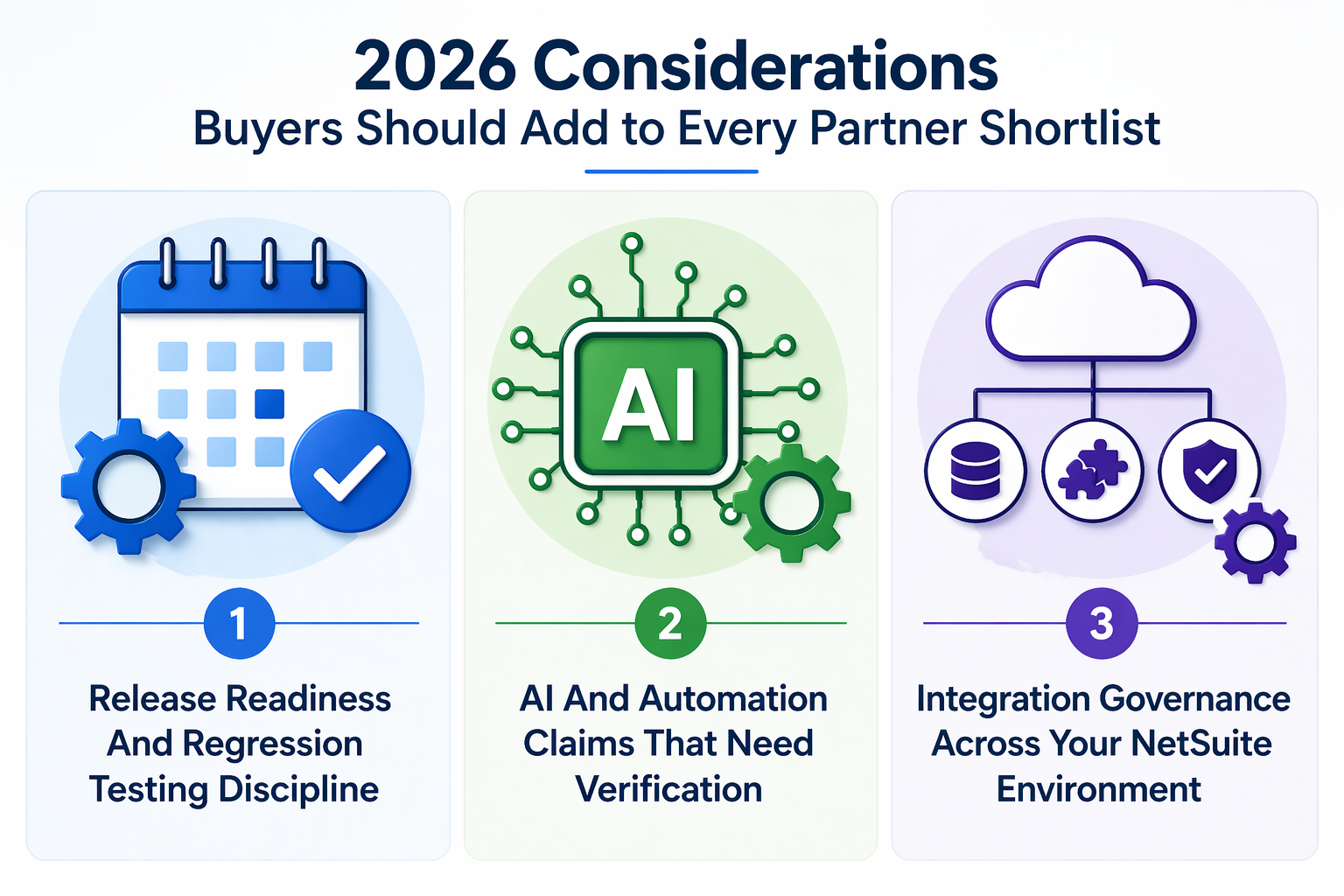
Release readiness deserves explicit ownership in every proposal. Oracle states that NetSuite delivers two product releases a year via automatic updates to all users, which means every custom script, workflow, saved search dependency, and integration should be tested on a recurring schedule. If the partner does not define who reviews release notes, who validates critical processes, and who signs off on regression testing, that responsibility will usually fall back on your internal team without warning.
This matters even more if your business relies on customized forms, approval logic, or external systems. A partner with strong release discipline will use sandbox testing, maintain a repeatable validation checklist, and flag changes that affect finance close, order processing, or reporting accuracy before they reach production.
AI is now part of the NetSuite buying conversation, but buyers should verify where it changes real work and where it is still general positioning. Gartner predicts 62% of cloud ERP spending will be on AI-enabled solutions by 2028, which makes it more important to ask implementation partners how automation will be applied to actual workflows rather than broad platform messaging.
Ask partners to identify specific use cases inside your ERP solution, such as transaction classification, anomaly review, forecasting support, or exception routing. Then ask what data quality, role permissions, workflow design, and testing controls are needed for those use cases to work. That conversation will tell you far more than a general statement that NetSuite is a powerful cloud platform with embedded AI.
Integrations create value when they eliminate duplicate entry, speed reporting, and connect operational systems. They create drag when ownership is scattered, and no one monitors failures, field changes, timing gaps, or reconciliation breaks. That is why integration governance should be part of partner evaluation, not a technical footnote.
Ask each partner how they document interfaces, manage API limits, handle failed syncs, track version changes, and assign ownership across internal IT, middleware vendors, and external applications. Strong NetSuite consulting services should show how integrations will be built and how they will be supported after go-live. Weak answers usually focus on technical possibility, not operational accountability.
Read Next:
NetSuite SOAP Endpoint Deprecation Is Coming: What Your Business Needs to Do Before 2026
A partner shortlist becomes more useful when you can compare what each firm will actually do in discovery, implementation, and support. Kimberlite Partners focuses on helping businesses align NetSuite with real operating requirements, which is especially useful when your team is weighing business needs, internal capacity, and long-term ownership. That matters for companies implementing a new ERP, stabilizing an existing deployment, or deciding whether the right NetSuite partner should also support optimization after go-live.
Implementation Alignment: Kimberlite Partners helps define how finance, operations, and reporting requirements translate into a practical project plan so your initial implementation is grounded in real workflows rather than generic templates.
Support Continuity: Teams that need steady issue resolution, user guidance, and system upkeep can extend capability through NetSuite Support Services instead of relying on reactive break-fix coverage.
Optimization Follow-Through: Businesses that already run NetSuite can use NetSuite Implementation Services, NetSuite Health Check, or NetSuite Managed Services to clean up reporting, reduce customization drag, and improve adoption.
That kind of continuity is useful because partner selection should reduce uncertainty after go-live, not just get a project contract signed.
Kimberlite Partners is a NetSuite Alliance Partner that works across implementation, optimization, and ongoing support scenarios, which makes the firm relevant for buyers who want clearer delivery ownership and a more stable path through their NetSuite journey. Book a meeting today to compare your current ERP constraints, implementation priorities, and post-go-live support needs with a team that understands how those choices affect delivery risk.
Selecting the right NetSuite partner is a strategic decision that impacts both the short-term and long-term success of your ERP implementation. The right partner should align with your industry focus, have the necessary expertise, and serve your region effectively.
Kimberlite Partners is a highly reputable NetSuite partner known for its comprehensive implementation, customization, training, and best-in-class support program (DiamondCare). With a proven track record of successful NetSuite deployments, Kimberlite Partners is an excellent starting point for your ERP journey. Get in touch today to explore how they can help you achieve your business objectives.
The NetSuite partners list is a directory of certified solution providers and implementation partners who are authorized to sell, support, or deploy Oracle NetSuite. It helps businesses find the right partner based on industry expertise and service offerings.
Top implementation partners are typically those recognized by Oracle with advanced certifications and strong customer success stories. Examples often include firms specializing in mid-market ERP rollouts, integrations, and vertical-specific deployments.
You can verify certifications by checking Oracle’s official partner directory. Certified providers are vetted by Oracle to ensure they meet training, sales, and service standards.
A reseller, also known as a solution provider, is primarily focused on licensing and advisory services. A broader NetSuite partner could also include implementation firms, consultants, or technology partners that focus on deploying and customizing the system.
A NetSuite alliance partner is a consulting and implementation firm that works with Oracle NetSuite to help customers deploy, configure, and optimize the platform. Alliance partners are consulting-focused firms, and they are different from solution providers because they do not typically sell NetSuite licenses directly. The useful question for buyers is whether the proposed delivery team has the industry experience, project controls, and support model needed for your implementation.
A NetSuite solution provider is an authorized partner that can consult, sell, and implement NetSuite for customers. This model is often a good fit for businesses that are still evaluating editions, modules, licensing structure, and the broader ERP rollout plan. Before you choose among solution providers, confirm who will handle discovery, integration planning, testing, training, and post-go-live support once the sales process is complete.
To assist you further, here’s an organized list of NetSuite partners, grouped by country:

Choosing a NetSuite implementation partner is one of the few ERP decisions that affects the operating problems you inherit later. The wrong partner...

Implementing NetSuite ERP isn’t just a software upgrade. It’s a high-stakes, enterprise-wide transformation. If you’re a CFO, IT leader, or project...

1 min read
How do you choose between two of the most powerful ERP systems available today—NetSuite and SAP? This decision is critical for any organization...